47 Shapes as topology
Level 4 · Researcher. Each shape is the square [0, 1)² of turns with some edges identified and some cut. This chapter says which, why y is centred at every cut, how the Klein bottle’s seam is twisted, and what the trefoil is as a knot. Read first: 16 One set of points, nine shapes and 41 The mapping.
The patch and its identifications
Every shape is a map P(s, t) on the patch (s, t) ∈ [0, 1]², fed by the turns: s = t_u, and t = t_v for a direction that closes, t = (t_v + ½) mod 1 for a direction that is cut. The identifications realised:
| shape | s = 0 ~ s = 1 | t = 0 ~ t = 1 | the surface |
|---|---|---|---|
| Torus, Lemniscate, Trefoil knot | glued | glued | a torus (embedded differently) |
| Cylinder | glued | cut | an annulus |
| Sphere, Ellipsoid, Icosahedron | glued | cut, each edge collapsed to a pole | a sphere |
| Wavy plane | cut | cut | a disc (the flat map itself) |
| Klein bottle | glued with t ↦ ½ − t | glued | a Klein bottle (immersed) |
Only the first row keeps both wrap-arounds; the others are pictures of the same torus torn along a known ring, which is useful precisely because the tear is at a known place.
Why y is centred at the cut
Negation is y ↦ p − y, that is t_v ↦ 1 − t_v. With t = (t_v + ½) mod 1 it becomes t ↦ 1 − t, a reflection of the patch about t = ½, which every cut shape realises as a reflection of space (through its mirror plane; the trefoil, having no mirror plane, inside each ring). Its fixed line t = ½ is y = 0, on the mirror, so the points with y = 0, their own negatives, sit on the mirror. The two edges t = 0 and t = 1, which the reflection swaps, are y ≈ p/2, where the cut runs; since p/2 is not an integer, no point of the curve lies on the cut itself.
Example 47.1 · The cut at y ≈ p/2: 2G and −2G at the poles
On F₂₂₃, 2G = (36, 111) and −2G = (36, 112): 111 < 223/2 < 112.
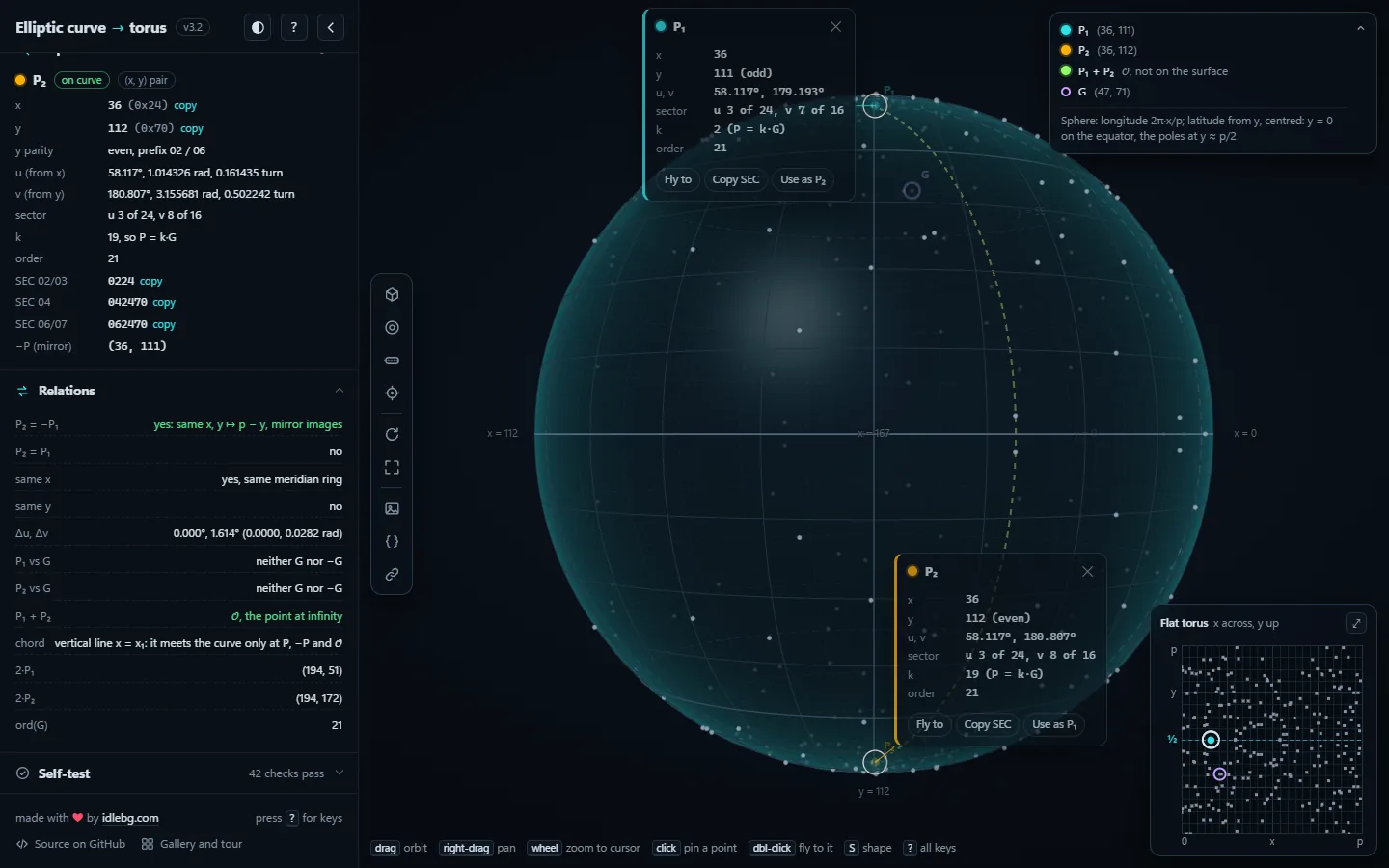
Open this view: 2G and −2G on the sphere
Do it yourself
- In Curve, pick the preset y² = x³ + 7 over F₂₂₃, Programming Bitcoin.
- Type
2Gin P₁. - Click the mirror button next to P₂ (its tooltip: “Set P₂ = −P₁, the mirror image”).
- In Shape, pick Sphere (or press S until it shows).
- In Display, turn off Chord construction (K).
- Press 3 for the side view.
- In the 3D view, click P₁ and P₂ to pin their cards.
- Read the Relations section in the panel.
Look at: on the sphere from the side, 2G sits at the north pole and −2G at the south pole. Relations: Δv = 1.614°, one step around the tube on the torus.
Why: the sphere cuts the torus exactly between y = 111 and y = 112 and pulls the two edges of the cut to opposite poles. Neighbours across the cut become antipodes; the torus, which cuts nothing, keeps them neighbours on its inner equator.
Example 47.2 · The Klein bottle’s twisted seam
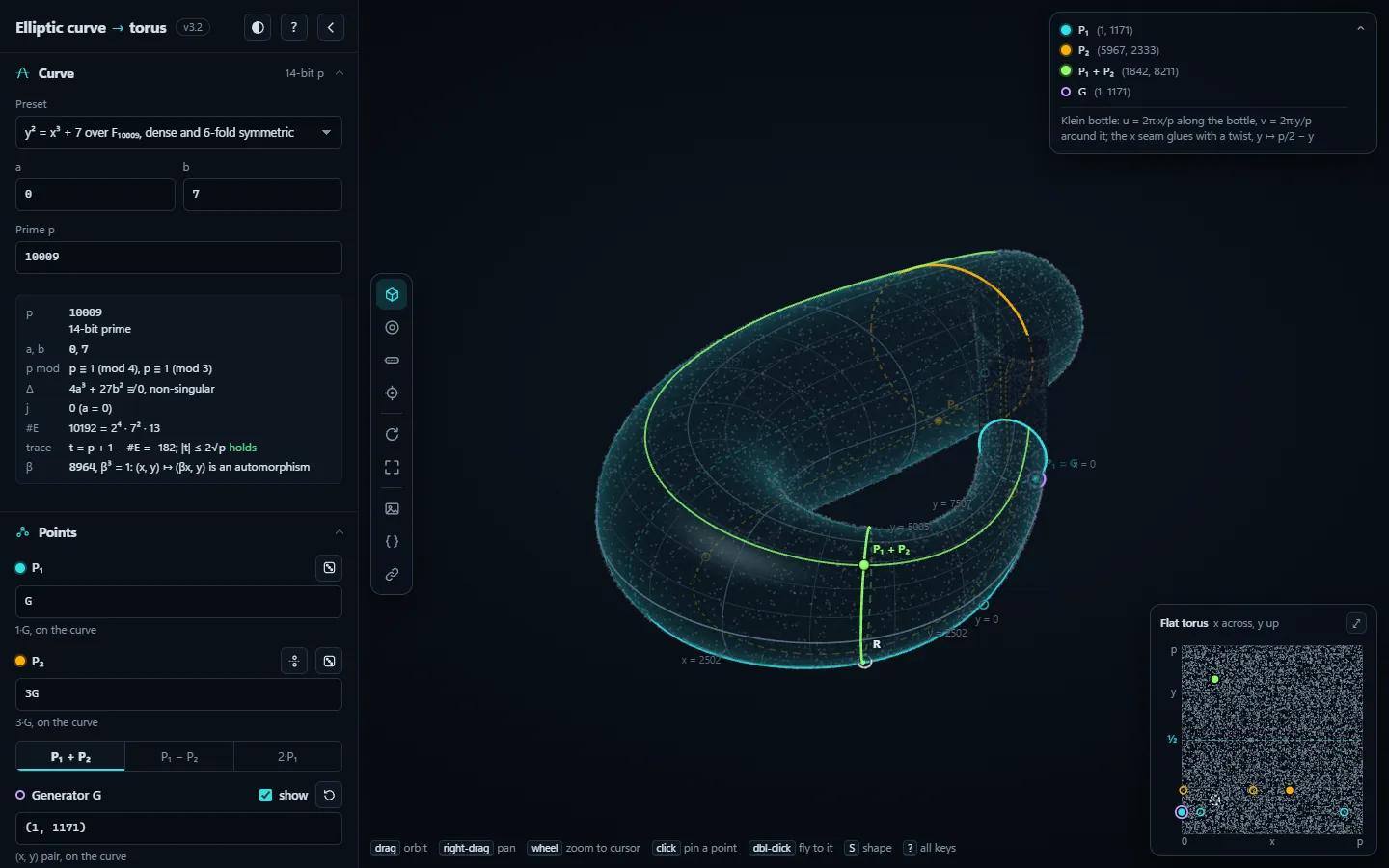
Open this view: F₁₀₀₀₉ on the Klein bottle
Do it yourself
- In Curve, pick the preset y² = x³ + 7 over F₁₀₀₀₉, dense and 6-fold symmetric.
- In Shape, pick Klein bottle (or press S until it shows).
- In Display, turn off Chord construction (K).
Look at: the 10 191 dots of F₁₀₀₀₉ on a surface that passes through itself (an immersion: a Klein bottle does not embed in 3D). Rings and the chord break at the seam.
Why: the shape glues s = 1 to s = 0 with t ↦ ½ − t (the build checks P(1, t) = P(0, ½ − t) at 21 values of t), so a line arriving at the seam at height y continues at p/2 − y. That glue is orientation-reversing: the surface has no outside, and the visualizer draws its glass and mask from both sides.
Example 47.3 · The trefoil as a (2, 3) torus knot
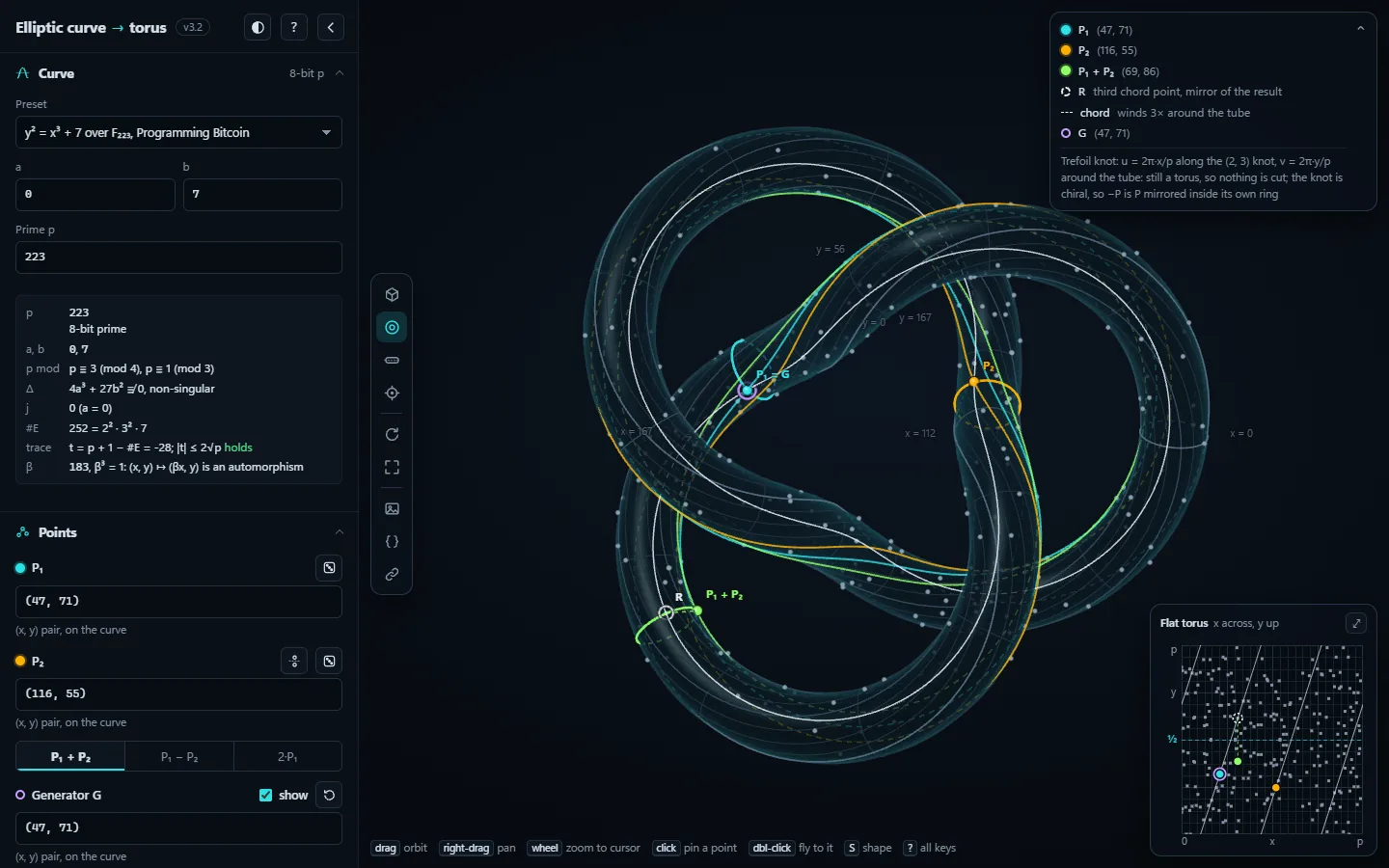
Open this view: F₂₂₃ on the trefoil, top view
Do it yourself
- In Curve, pick the preset y² = x³ + 7 over F₂₂₃, Programming Bitcoin.
- In Shape, pick Trefoil knot (or press S until it shows).
- Press 2 for the top view.
Look at: from the top, the tube runs twice around the centre and through three lobes.
Why: the core is C(θ) = ((A + B cos 3θ) cos 2θ, (A + B cos 3θ) sin 2θ, B sin 3θ) with A = R and B = 0.45·A, a curve on the torus of radii (A, B) that goes 2 times around its axis and 3 times around its tube: the (2, 3) torus knot, the trefoil. The build checks both facts on the live shape: the tube’s centre (the mean of P(s, 0) and P(s, ½)) lies on C(2πs) at 40 values of s, and turns twice around the axis as s runs once. The tube of radius 0.42·r around it is framed by the normal of that torus, which is perpendicular to the knot because the knot lies on it. As a surface the tube is still a torus, so nothing is cut; but the knot is chiral, so no reflection of space maps it to itself, and −P is realised as the reflection inside its own ring (15).
Try it yourself
- In Example 47.1, switch to the cylinder: 2G and −2G are now at the top and bottom edges.
- Put a chord across the Klein bottle’s seam (F₂₂₃’s preset, then the Klein bottle) and follow where it reappears.
- On the trefoil, compare the side view with the torus’s: the mirror plane is not drawn.
Recap
- Torus, lemniscate and trefoil identify both edges; cylinder and the spheres cut y; the wavy plane cuts both; the Klein bottle glues x with t ↦ ½ − t.
- y is centred at every cut, so negation is the reflection t ↦ 1 − t and y = 0 lies on the mirror.
- The trefoil’s core is the (2, 3) torus knot; being chiral, it realises −P inside each ring.
Next: 48 Scripting with ecTorus.