28 Orders and subgroups
Level 2 · Learner. You will learn what the order of a point is, what the subgroup generated by G and the cofactor are, and why some points of a curve have an order but no k. Read first: 27 Walking the multiples.
The order of a point
Keep adding a point to itself: P, 2P, 3P, … Sooner or later you reach 𝒪, because the curve has only finitely many points. The first n with nP = 𝒪 is the order of P. The visualizer shows it on every card of P₁, P₂, the result and G (for p up to 2²²), and Relations gives ord(G).
Two rules from group theory hold on every curve:
- the order of every point divides #E, the number of points (Lagrange’s theorem);
- the multiples of G, from G up to ord(G)·G = 𝒪, form a smaller group of their own, the subgroup generated by G, written ⟨G⟩. The ratio #E / ord(G) is the cofactor.
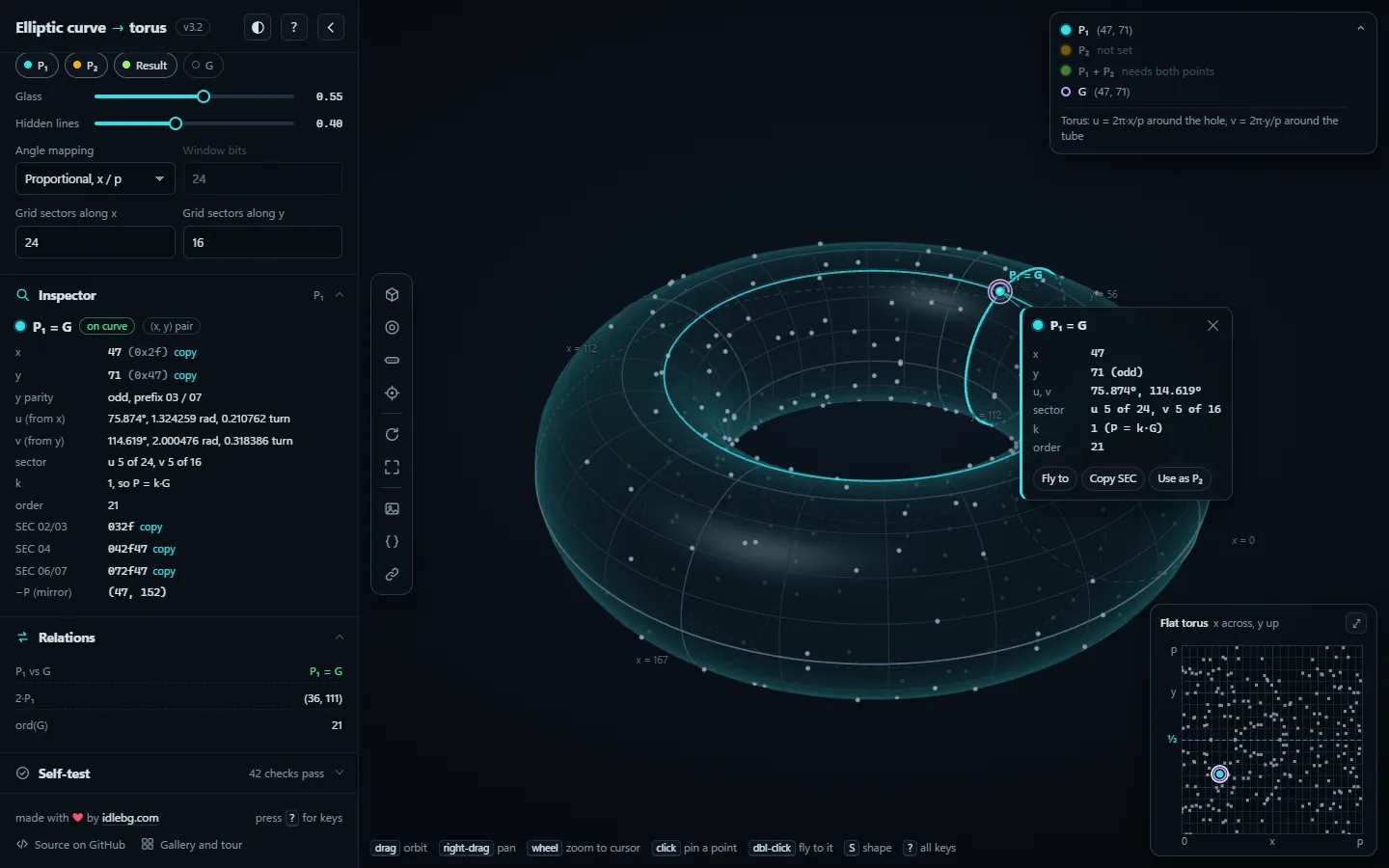
Example 28.1 · ord(G) = 21 on a curve of 252 points
Open this view: G on F₂₂₃
Do it yourself
- In Curve, pick the preset y² = x³ + 7 over F₂₂₃, Programming Bitcoin.
- Empty P₂.
- In Display, turn off Chord construction (K).
- In the 3D view, click P₁ to pin its card.
- Read the Relations section in the panel.
Look at: G’s card and Relations: order 21. The Curve facts: #E = 252 = 2² · 3² · 7.
Why: 21 divides 252, as Lagrange promises, and the cofactor is 252 / 21 = 12. So ⟨G⟩ holds only one point in twelve. Bitcoin’s curve is the opposite: there the cofactor is 1, and G’s multiples are every point of the curve (31 secp256k1 in the panel).
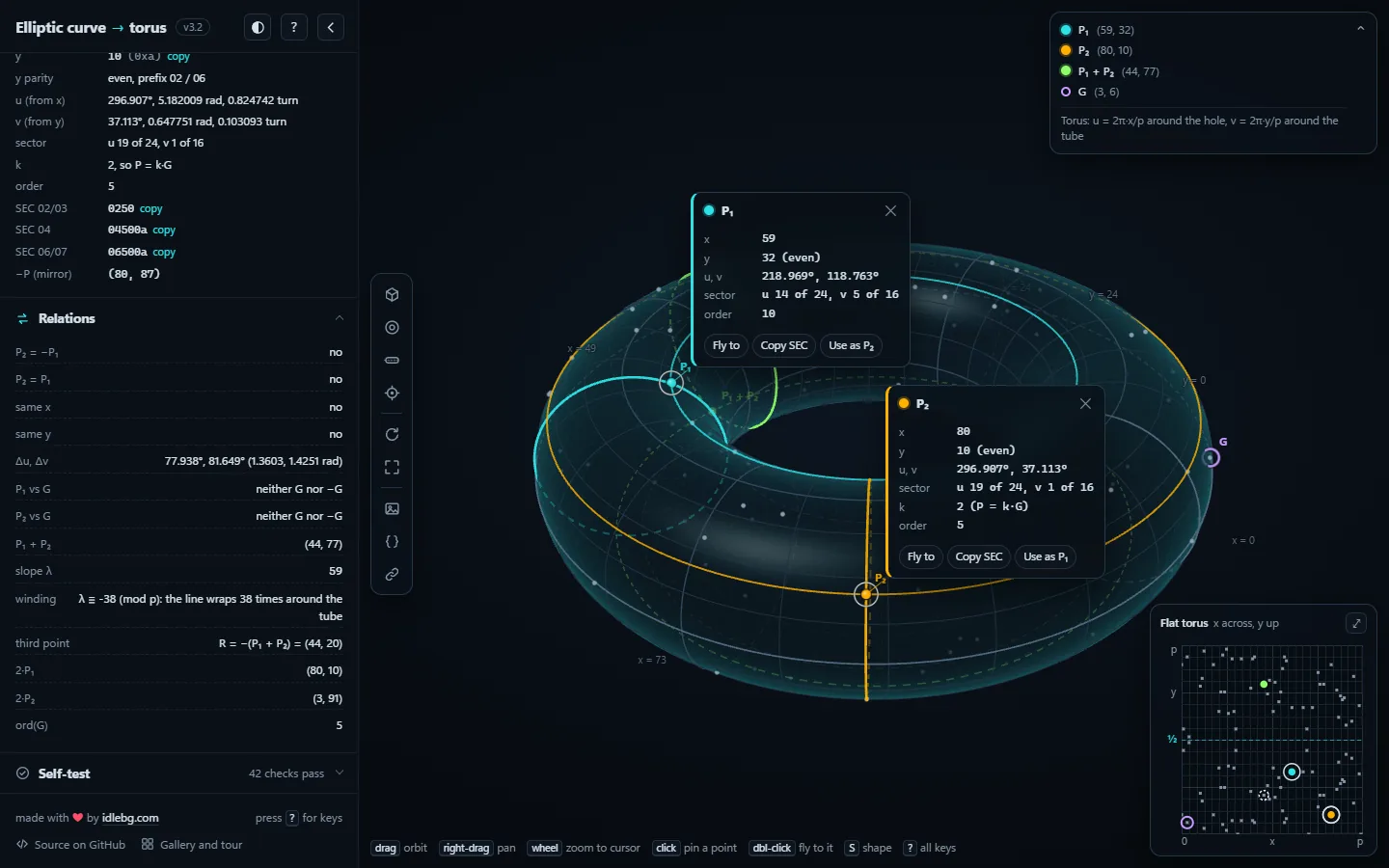
Example 28.2 · Orders on F₉₇: 5 and 10
The preset “y² = x³ + 2x + 3 over F₉₇, a point of order 5”.
Open this view: (59, 32) and (80, 10) on F₉₇
Do it yourself
- In Curve, pick the preset y² = x³ + 2x + 3 over F₉₇, a point of order 5.
- Type
(59, 32)in P₁. - In Display, turn off Chord construction (K).
- In the 3D view, click P₁ and P₂ to pin their cards.
- Read the Relations section in the panel.
Look at: ord(G) is 5 (G = (3, 6)); P₁ = (59, 32) has order 10 and no k; P₂ = (80, 10) has order 5 and k = 2.
Why: #E = 100 = 2² · 5², and 5 and 10 both divide 100. ⟨G⟩ has only five points (G, (80, 10), (80, 87), (3, 91) and 𝒪), so (59, 32), whose order 10 does not divide 5, cannot be one of them: it has an order and no k.
Not every curve is one big loop
A group in which one point generates everything is cyclic. F₁₇ (19 points, every point a generator) is cyclic. F₂₂₃ is not: no point has order 252. Its largest order is 42, and the group is built like Z/6 × Z/42, a pair of clocks with 6 and 42 hours, turning independently. The visualizer lets you see the consequence.
Example 28.3 · Not cyclic: a β-orbit outside ⟨G⟩
Open this view: (92, 47) + (20, 47) with the β-orbit
Do it yourself
- In Curve, pick the preset y² = x³ + 7 over F₂₂₃, Programming Bitcoin.
- Type
(92, 47)in P₁ and(20, 47)in P₂. - In Display, turn on β-orbit (B).
- Press 2 for the top view.
- In the 3D view, click the result to pin its card.
- In the 3D view, hover P₂; its card stays until you hover another point.
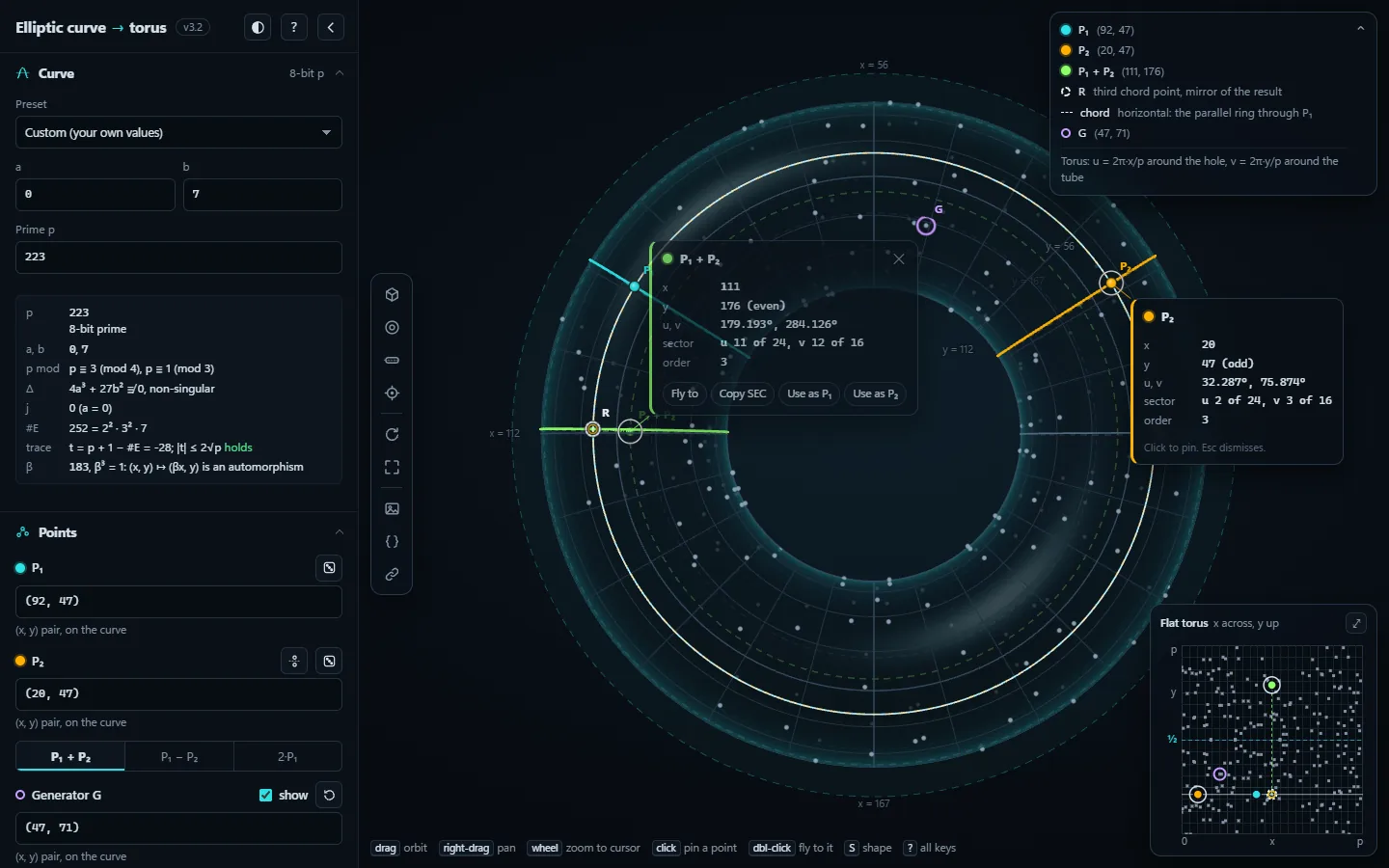
Look at: P₁ = 7G = (92, 47) has order 3 and k = 7. P₂ = (20, 47) also has order 3, but no k. With the β-orbit switch on, the small rings mark the third point of the same height, (111, 47), which has order 3 too. The sum (92, 47) + (20, 47) = (111, 176) has no k either.
Why: a cyclic group has exactly two points of order 3. F₂₂₃ has eight of them, and only two, 7G and 14G, are in ⟨G⟩. The others lie in other subgroups of order 3, out of G’s reach. 35 The GLV endomorphism explains why the three points with y = 47 belong together.
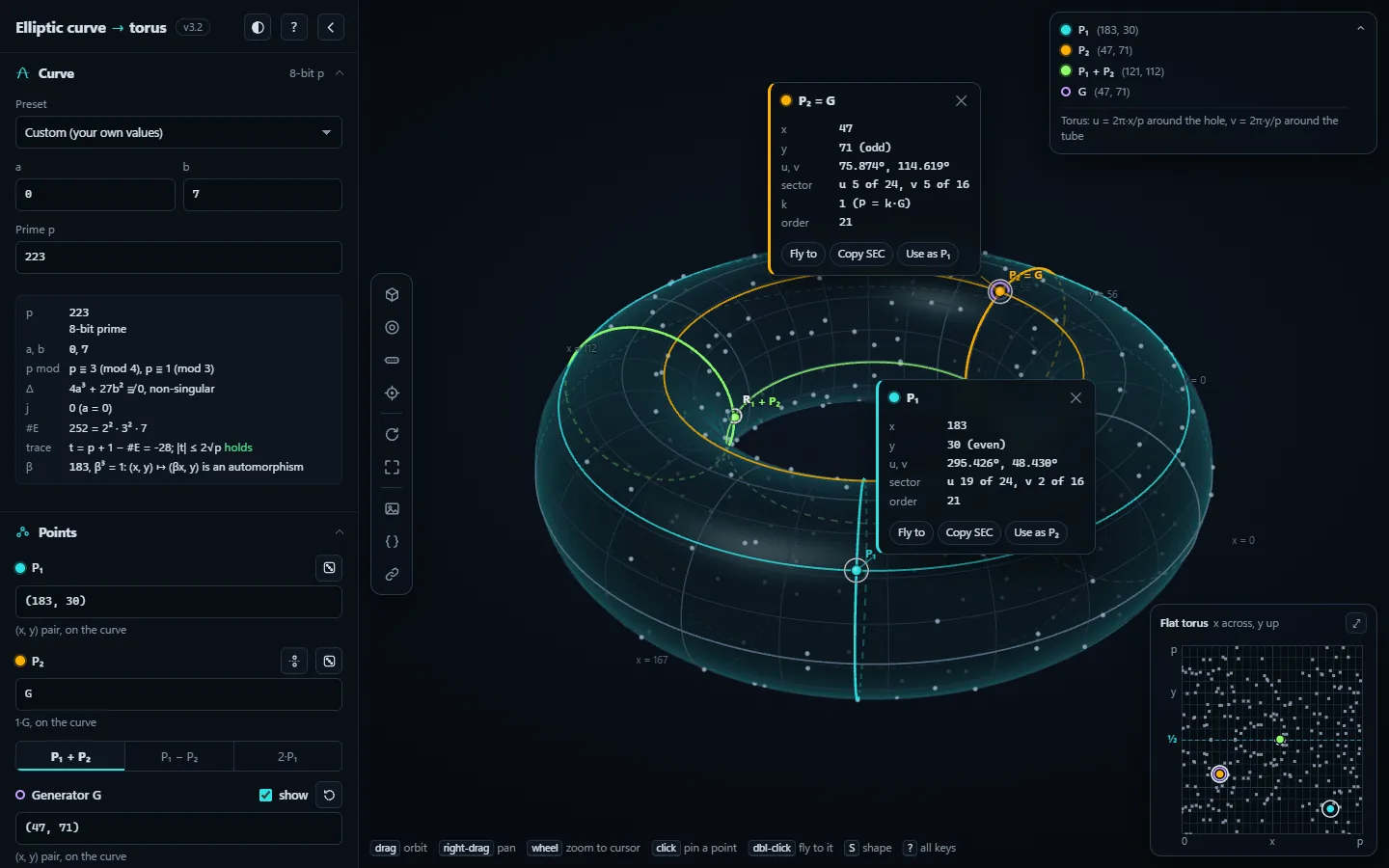
Example 28.4 · Order 21, but not a multiple of G
Open this view: (183, 30) and G
| order | points of that order | one of them | its k | open |
|---|---|---|---|---|
| 2 | 3 | (206, 0) | — | open |
| 3 | 8 | (92, 47) | 7 | open |
| 6 | 24 | (133, 70) | — | open |
| 7 | 6 | (139, 86) | 15 | open |
| 14 | 18 | (167, 28) | — | open |
| 21 | 48 | (126, 96) | 5 | open |
| 42 | 144 | (125, 105) | — | open |
Do it yourself
- In Curve, pick the preset y² = x³ + 7 over F₂₂₃, Programming Bitcoin.
- Type
(183, 30)in P₁ andGin P₂. - In Display, turn off Chord construction (K).
- In the 3D view, click P₁ and P₂ to pin their cards.
Look at: (183, 30) has order 21, exactly like G, and still no k. The table lists every order a point of F₂₂₃ can have, how many points have it, and one example of each; the rows open in the visualizer.
Why: F₂₂₃ has several subgroups of order 21; ⟨G⟩ is one of them, and (183, 30) generates another. Counting the table: 1 + 3 + 8 + 24 + 6 + 18 + 48 + 144 = 252, with 𝒪 as the one point of order 1. Most points, 144 points of order 42, have the largest order; F₉₇ has the same kind of structure, Z/2 × Z/50.
Try it yourself
- On F₂₂₃, find a point of order 42 among the dots (pin one and click Use as P₁). Can any multiple of it be G?
- On F₁₇, check that every point has order 19.
- Type the F₉₇ point (59, 32) into P₁ and press N with the operation 2·P₁: the doubles have order 5.
Recap
- The order of P is the smallest n with nP = 𝒪; it divides #E. The cofactor is #E / ord(G).
- A curve’s group can be cyclic (F₁₇) or not (F₂₂₃ ≅ Z/6 × Z/42).
- Points outside ⟨G⟩ have an order but no k; the visualizer shows exactly that.