29 Discrete logs on toy curves
Level 2 · Learner. You will learn what the discrete logarithm problem is, how the visualizer solves it on small curves, and why the same method cannot touch Bitcoin’s curve. Read first: 28 Orders and subgroups.
The problem
Given G and a point Q, find the number k with k·G = Q. This is the discrete logarithm of Q. Going forward, from k to kG, is fast (doubling and adding, 27). Going back is the hard direction, and the security of Bitcoin’s signatures rests on it: a public key is kG, and k is the private key.
On curves with p up to 2²² the visualizer solves it for every point you type whose order divides ord(G), and writes the answer as the card’s k. It uses baby-step giant-step:
- compute the “baby steps” 0·G, 1·G, …, (m − 1)·G, with m about √ord(G), and remember them;
- from Q, take “giant steps” backwards, subtracting m·G each time, until you land on a baby step: if Q − i·mG = jG, then k = i·m + j.
That needs about 2√ord(G) additions instead of ord(G).
Example 29.1 · Every k on F₁₇
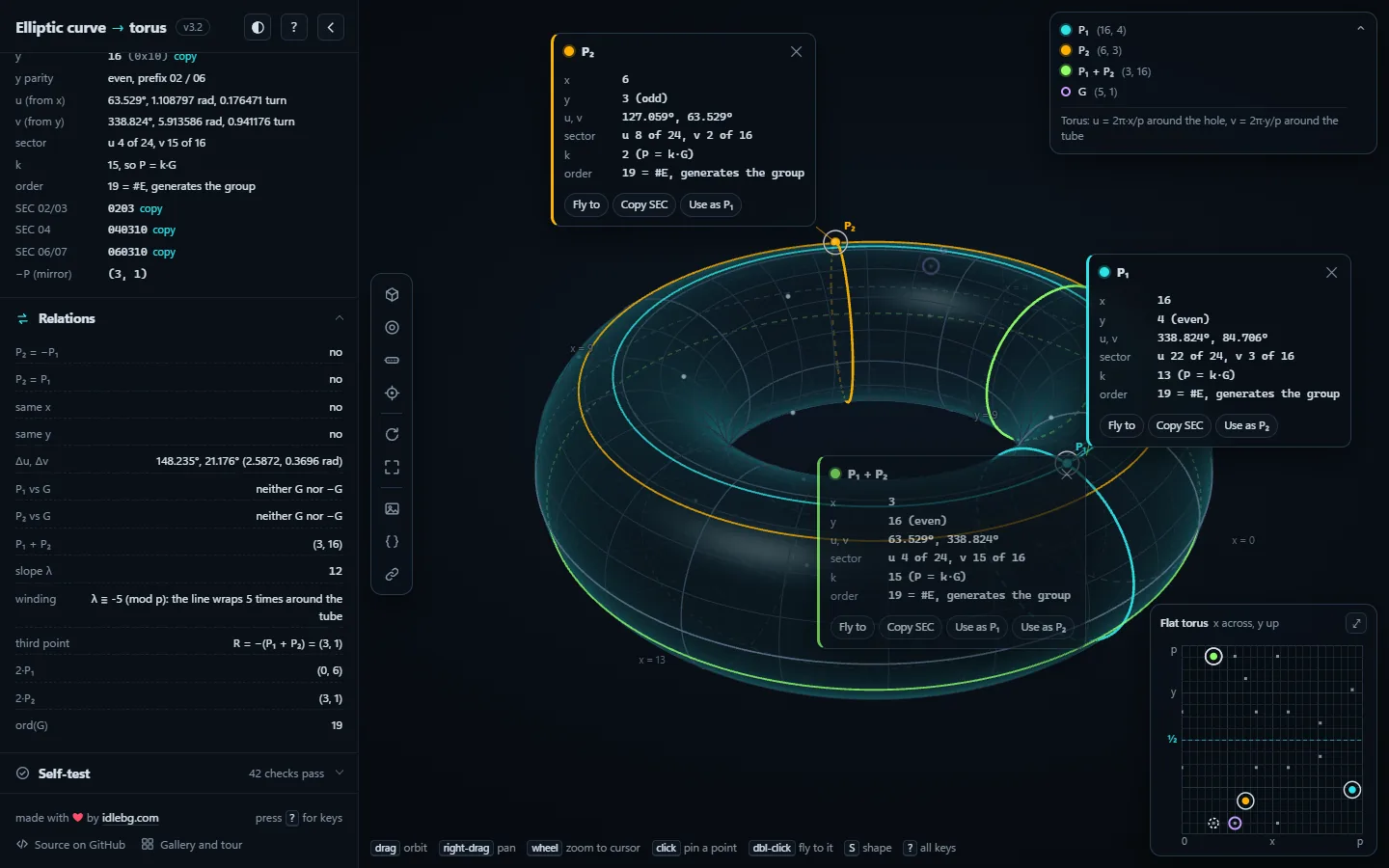
Open this view: (16, 4) + (6, 3) on F₁₇
Do it yourself
- In Curve, pick the preset y² = x³ + 2x + 2 over F₁₇, Paar & Pelzl.
- Type
(16, 4)in P₁. - In Display, turn off Chord construction (K).
- In the 3D view, click P₁, P₂ and the result to pin their cards.
- Read the Relations section in the panel.
Look at: three cards with k: (16, 4) = 13G, (6, 3) = 2G, and their sum (3, 16) = 15G.
Why: 13 + 2 = 15, so the sum of the points is the point of the summed k: adding points adds their k. That rule is why the visualizer can carry k through operations, and why kG is a group homomorphism, in the language of Level 4.
Example 29.2 · Discrete logs on F₁₀₀₀₉
On y² = x³ + 7 over F₁₀₀₀₉, G = (1, 1171) has order 2548, so the cofactor is 10192 / 2548 = 4. Type a point as plain (x, y): the visualizer does not know where it came from, and finds k itself.
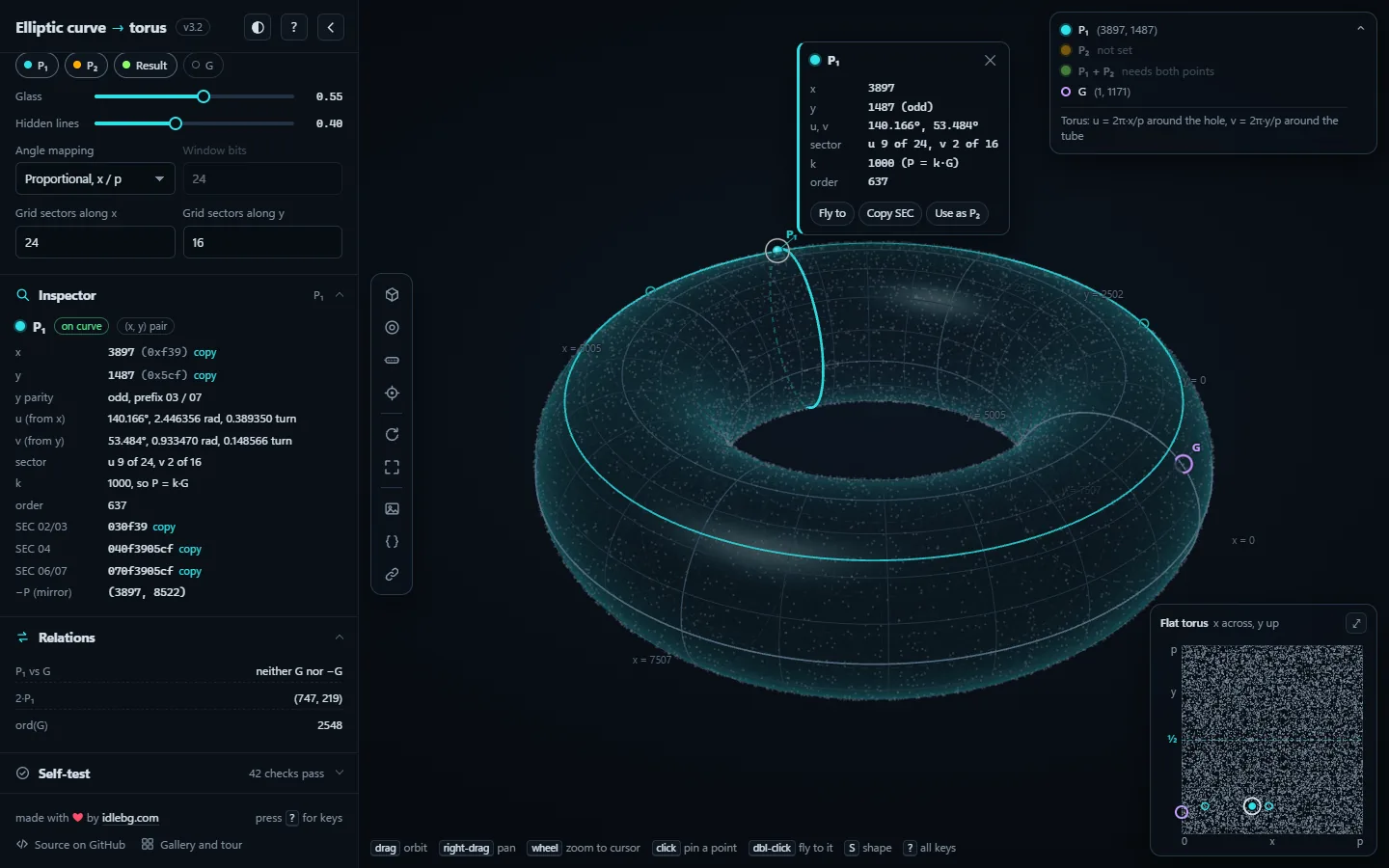
Open this view: (3897, 1487) on F₁₀₀₀₉
| P₁ typed as (x, y) | k found by the visualizer | open |
|---|---|---|
(2298, 3395) |
100 | open |
(3897, 1487) |
1000 | open |
(747, 219) |
2000 | open |
(1, 8838) |
2547 | open |
Do it yourself
- In Curve, pick the preset y² = x³ + 7 over F₁₀₀₀₉, dense and 6-fold symmetric.
- Type
(3897, 1487)in P₁. - Empty P₂.
- In Display, turn off Chord construction (K).
- In the 3D view, click P₁ to pin its card.
- Read the Inspector section in the panel.
Look at: (3897, 1487) gets k = 1000. The table gives three more points and the k the visualizer found for each; the points were made by the tutorials’ scripts as 100G, 2000G and 2547G, and the visualizer recovers exactly those numbers.
Why: with ord(G) = 2548, baby-step giant-step stores 51 baby steps (51 is ⌈√2548⌉) and takes at most about as many giant steps. 2547G is −G, the mirror image of G = (1, 1171): look at its x.
Example 29.3 · No k: a point outside ⟨G⟩
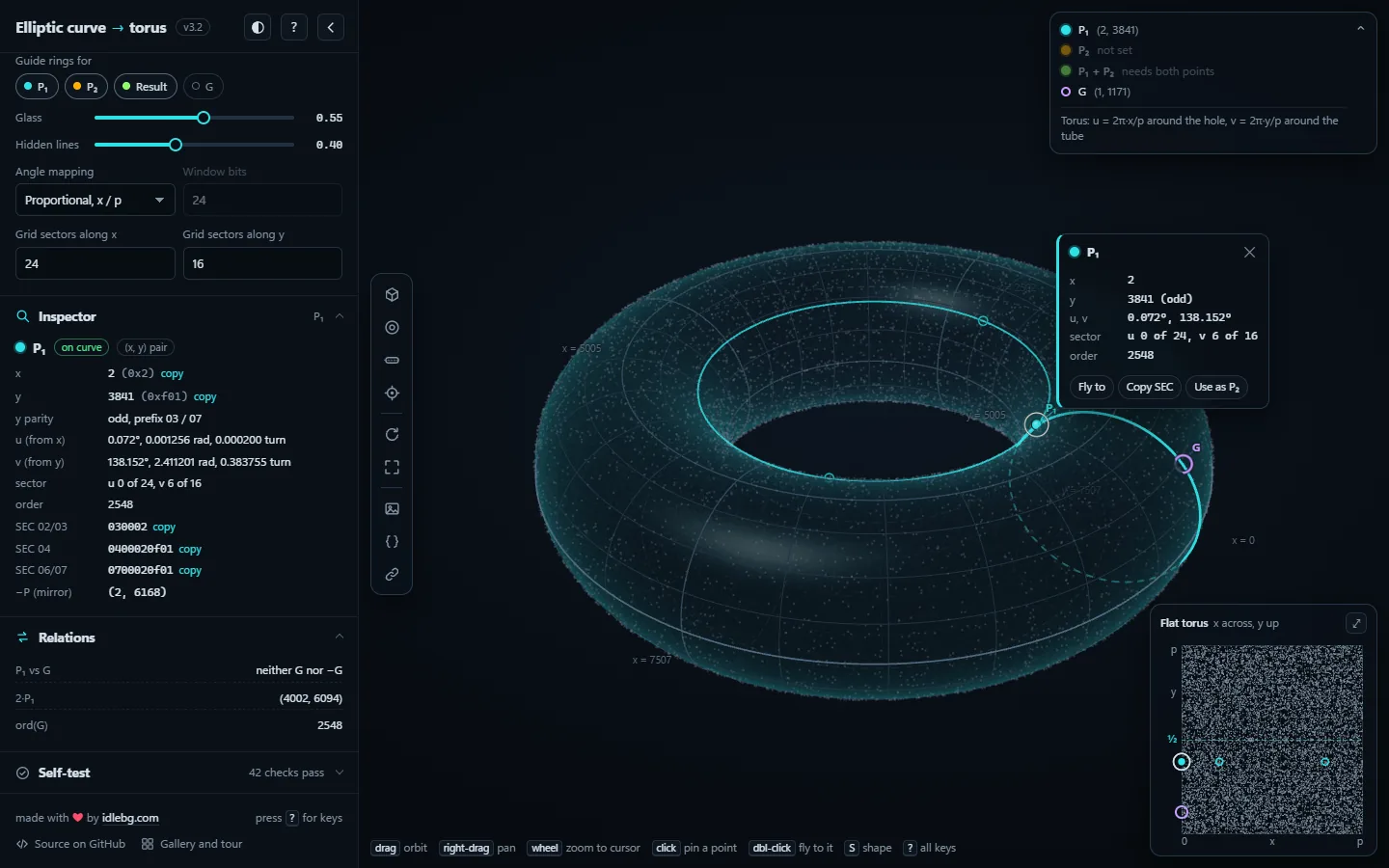
Open this view: (2, 3841) on F₁₀₀₀₉
Do it yourself
- In Curve, pick the preset y² = x³ + 7 over F₁₀₀₀₉, dense and 6-fold symmetric.
- Type
(2, 3841)in P₁. - Empty P₂.
- In Display, turn off Chord construction (K).
- In the 3D view, click P₁ to pin its card.
- Read the Inspector section in the panel.
Look at: (2, 3841) has order 2548, the same as G, but its card has no k.
Why: with cofactor 4, only one point in four is a multiple of G. The search runs to its end without landing on a baby step, and that proves Q is not in ⟨G⟩: there is no k to find.
Why Bitcoin’s curve is safe from this
On secp256k1, G has order n, a 256-bit number. Baby-step giant-step would need about √n steps, about 3.403 × 10³⁸, and storage for as many points. No computer, and no number of computers, comes anywhere near that; no better general method is known either (Pollard’s rho needs about the same √n time with little memory). That is the gap between the two directions: kG takes a few hundred curve operations, k from kG takes about 10³⁸.
The visualizer never attempts a discrete log on secp256k1 or P-256. It shows k only where it was given, typed as kG,
and carries it through operations (Example 26.2).
Try it yourself
- On F₁₀₀₀₉, click the dice next to P₁ a few times: about one point in four gets a k.
- On F₂₂₃ (cofactor 12), do the same: how often does a k appear?
- On F₁₇, type the points of Example 29.1 the other way round, and choose P₁ − P₂: which k does the result get?
Recap
- The discrete log of Q is the k with kG = Q; the visualizer finds it for p up to 2²² with baby-step giant-step, in about 2√ord(G) steps.
- Points outside ⟨G⟩ have no k; the search proves it.
- On secp256k1 the same search would take about 3.403 × 10³⁸ steps: that gap is Bitcoin’s security.
Next, Level 3 begins: 31 secp256k1 in the panel. Or continue with Level 4 at 41 The mapping.