43 j = 0 and its automorphisms
Level 4 · Researcher. Curves with a = 0 (j-invariant 0) have six automorphisms instead of two. You will see their orbits on F₂₁₁ and F₁₀₀₀₉, and what happens when p ≡ 2 (mod 3): the curve becomes supersingular with exactly p + 1 points. Read first: 35 The GLV endomorphism.
The automorphism group
For p > 3, j(E) = 1728 · 4a³ / (4a³ + 27b²), so j = 0 exactly when a = 0 (the j row says “0 (a = 0)”). Every curve has the automorphisms ±1: (x, y) ↦ (x, ±y). A curve y² = x³ + b over F_p with p ≡ 1 (mod 3) has more: with β a primitive cube root of unity, (x, y) ↦ (βx, −y) has order 6 and generates
Aut(E) ≅ μ₆ = {(x, y) ↦ (βⁱx, ±y)}.
Its orbits on the affine points have size 6, except for the points with y = 0 (one orbit of size 3, when x³ + b splits) and with x = 0 (an orbit (0, ±y) of size 2, when b is a square).
Example 43.1 · Three points share y = 33 on F₂₁₁
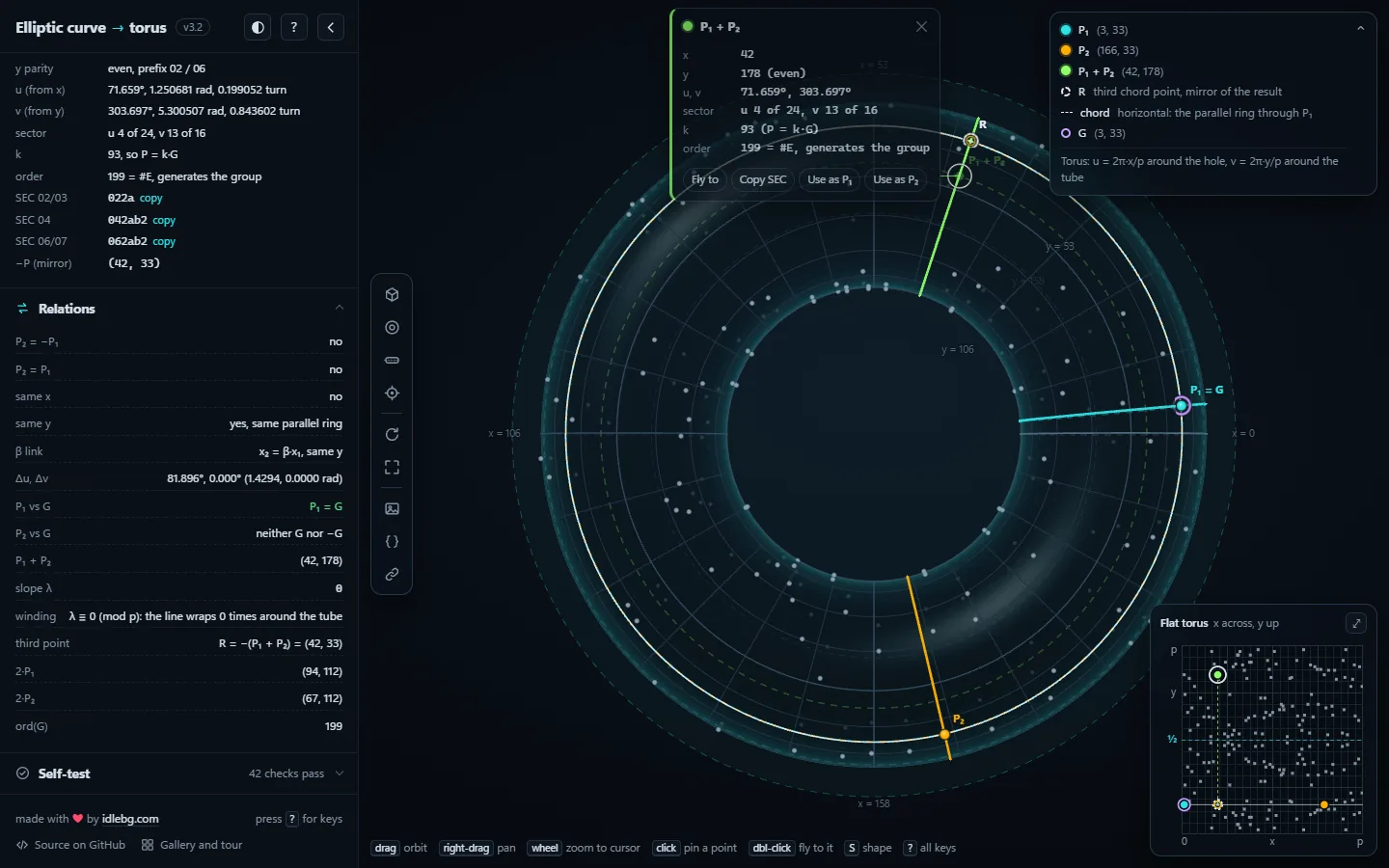
Open this view: the F₂₁₁ preset from the top
Do it yourself
- In Curve, pick the preset y² = x³ + 7 over F₂₁₁, three points share y = 33.
- Press 2 for the top view.
- In the 3D view, click the result to pin its card.
- Read the Relations section in the panel.
Look at: the preset “three points share y = 33”: (3, 33) and (166, 33), with the β-orbit marking the third, (42, 33). Relations: β link “x₂ = β·x₁, same y”. The chord is the ring y = 33 itself, so its third point is R = (42, 33) and the sum is (42, 178).
Why: here β = 196 and β² = 14: 196 × 3 = 588 ≡ 166 and 14 × 3 = 42 (mod 211). F₂₁₁’s group is cyclic of prime order 199, and the automorphism acts on it as multiplication by a cube root of unity mod 199, as λ does on secp256k1.
Example 43.2 · Six points from one on F₁₀₀₀₉

Open this view: (3293, 4199) and its five siblings
Do it yourself
- In Curve, pick the preset y² = x³ + 7 over F₁₀₀₀₉, dense and 6-fold symmetric.
- Type
(3293, 4199)in P₁. - Click the mirror button next to P₂ (its tooltip: “Set P₂ = −P₁, the mirror image”).
- In Display, turn off Chord construction (K).
- Press 2 for the top view.
Look at: from the top, the six marked points (1911, 4199), (1911, 5810), (3293, 4199), (3293, 5810), (4805, 4199), (4805, 5810): three x values on each of two rings, mirror images of each other.
Why: this is one μ₆-orbit (β = 8964 as the visualizer picks it). F₁₀₀₀₉ has no point with x = 0 (7 is not a square mod 10009) and three points with y = 0, so its 10 191 dots split into one orbit of three and 1698 orbits of six. That is the “6-fold symmetric” of the preset’s name, and why every row of its flat map has three dots or none (12).
p ≡ 2 (mod 3): supersingular
If p ≡ 2 (mod 3), then 3 ∤ p − 1 and x ↦ x³ is a bijection of F_p. So for each y there is exactly one x with x³ = y² − b: the curve has exactly one point per value of y, p affine points in all, and #E = p + 1. Such a curve is supersingular (trace 0), its β row says so, and no β exists to give an automorphism of order 3 over F_p.
Example 43.3 · p ≡ 2 (mod 3): one point per row

Open this view: y² = x³ + 7 over F₂₂₇
Do it yourself
- In Curve, pick the preset y² = x³ + 7 over F₂₂₃, Programming Bitcoin.
- Type
227in Prime p,(0, 190)in Generator G and(0, 190)in P₁. - Empty P₂.
- Click ⤢ on the flat map to enlarge it.
- Read the Curve section in the panel.
Look at: the facts: p mod “p ≡ 3 (mod 4), p ≡ 2 (mod 3)”, #E “228 = 2² · 3 · 19”, and β “none (p ≡ 2 mod 3): x ↦ x³ is a bijection, so this curve is supersingular with #E = p + 1”. The enlarged flat map has exactly one dot in every row.
Why: y² = x³ + 7 over F₂₂₇ has the 227 points (x(y), y), one for each y, plus 𝒪. Only one of them has y = 0, (143, 0), the unique cube root of −7.
Try it yourself
- On F₂₁₁, type (42, 33) into P₂: the β link now says β², and the chord still runs along the ring.
- Type y² = x³ + 7 with p = 229 (≡ 1 mod 3) and p = 233 (≡ 2 mod 3) and compare their flat maps.
- On F₁₀₀₀₉, type a point with y = 0: its β-orbit has three points, all on the outer rim.
Recap
- j = 0 ⇔ a = 0; for p ≡ 1 (mod 3) the automorphism group is μ₆: (x, y) ↦ (βⁱx, ±y).
- Orbits have size 6, except 3 for y = 0 and 2 for x = 0; that is the six-fold pattern of F₁₀₀₀₉.
- For p ≡ 2 (mod 3), x ↦ x³ is a bijection: one point per y, #E = p + 1, supersingular.
Next: 44 Quadratic twists.