24 Adding points: the chord
Level 2 · Learner. You will learn how two points of a curve are added, do one addition by hand, and see why the line through them winds around the donut. Read first: 21 Clock arithmetic and 23 Negation.
The chord rule
To add two points P₁ and P₂ of an elliptic curve:
- draw the line through them, the chord;
- it meets the curve in exactly one more point, R;
- the sum is the mirror image of R: P₁ + P₂ = −R.
Why exactly one more point? Put the line y = λx + c into the curve’s equation. You get an equation of degree 3 in x, and a cubic has three roots. Two of them are x₁ and x₂, the points you started with, so the third one is forced. For a cubic x³ − λ²x² + …, the three roots add up to λ², which gives the formula
x₃ = λ² − x₁ − x₂, then R = (x₃, λx₃ + c), and P₁ + P₂ = (x₃, −(λx₃ + c)).
Here λ (“lambda”) is the slope, λ = (y₂ − y₁) / (x₂ − x₁), with the division done mod p (multiply by the inverse).
Example 24.1 · G + 8G = 9G: the chord winds three times
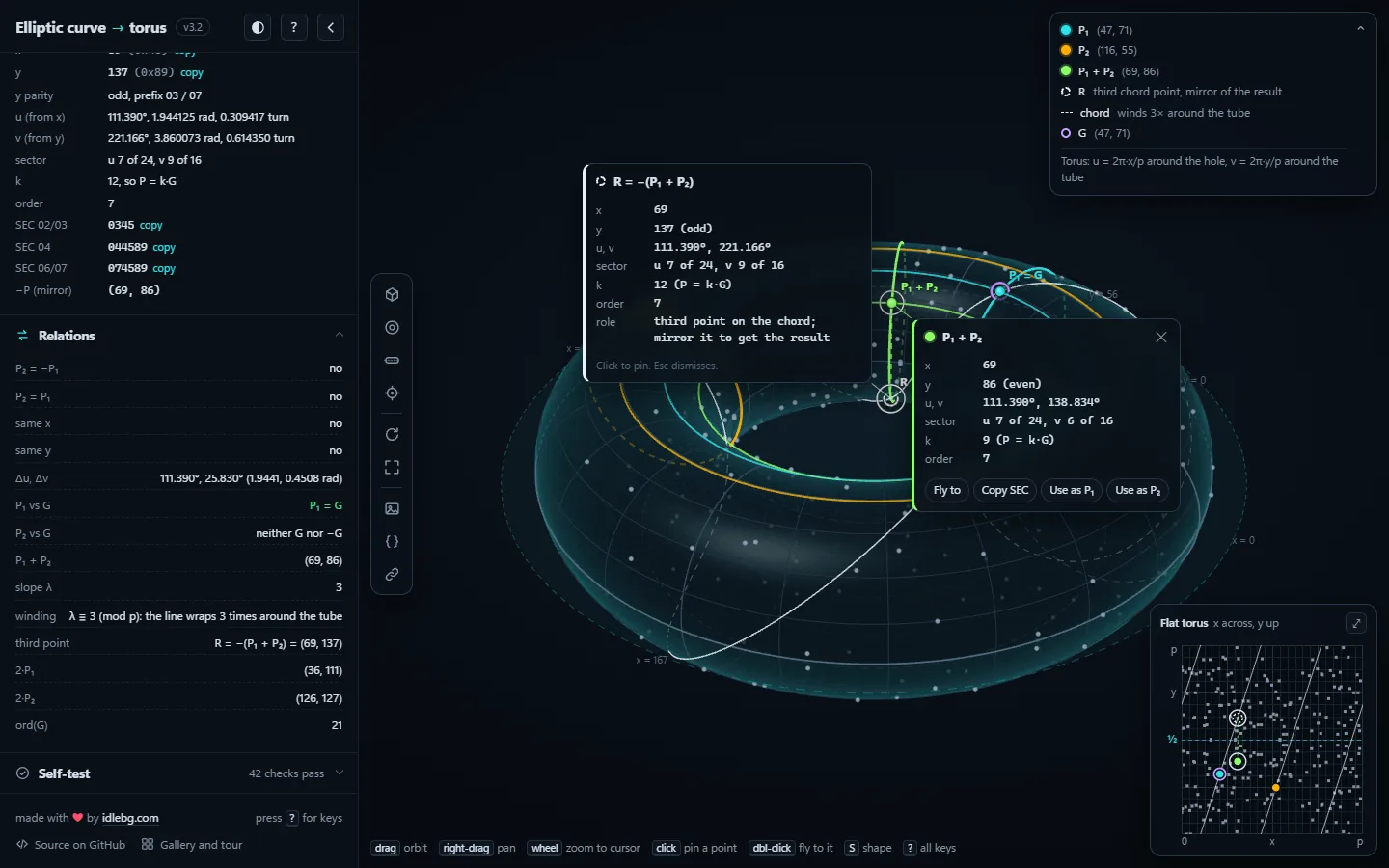
The preset “y² = x³ + 7 over F₂₂₃, Programming Bitcoin” opens with exactly this addition: P₁ = G = (47, 71) and P₂ = 8G = (116, 55).
Open this view: G + 8G on F₂₂₃
Do it yourself
- In Curve, pick the preset y² = x³ + 7 over F₂₂₃, Programming Bitcoin.
- In the 3D view, click the result to pin its card.
- In the 3D view, hover R; its card stays until you hover another point.
- Read the Relations section in the panel.
Look at:
- the white line through G and 8G, winding around the tube three times while it goes once around the hole;
- the dashed ring R = (69, 137), where the line meets the curve again, and the short dashed mirror step from R to the green result (69, 86), whose card says k = 9;
- Relations: slope λ = 3, winding “λ ≡ 3 (mod p): the line wraps 3 times around the tube”, third point R = (69, 137), and P₁ + P₂ = (69, 86).
Why: by hand, mod 223:
- λ = (55 − 71) / (116 − 47) = −16 / 69. Is it 3? Check: 3 × 69 = 207, and 207 ≡ −16 because 207 + 16 = 223. Yes, λ = 3.
- x₃ = 3² − 47 − 116 = −154, and −154 + 223 = 69.
- the sum’s y: 3 × (47 − 69) − 71 = −137, which is 86 on the clock. So G + 8G = (69, 86), and R = (69, 137) is its mirror image.
The line itself is y ≡ 3x + 153 (mod 223), so c = 153. As x runs once around (0 to 223), 3x runs three times as far, so the line wraps three times around the tube: that is the winding the legend reports.
Example 24.2 · On the flat map: three parallel segments
Open this view: G + 8G, flat map enlarged
Do it yourself
- In Curve, pick the preset y² = x³ + 7 over F₂₂₃, Programming Bitcoin.
- Click ⤢ on the flat map to enlarge it.
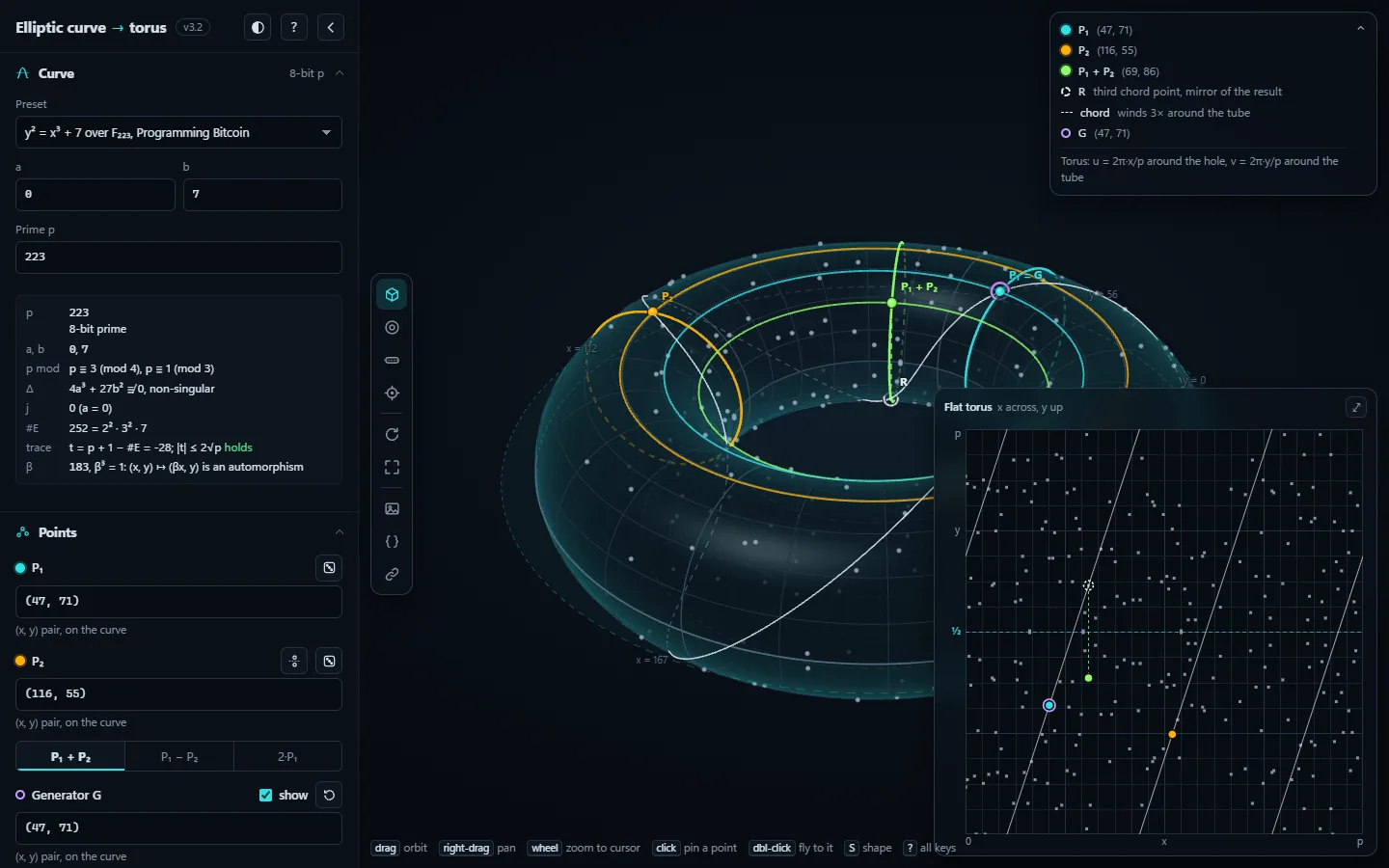
Look at: the enlarged flat map. The line is drawn as three parallel segments: each time it leaves the top edge it comes back at the bottom, because y wraps at 223.
Why: a line on the torus is a straight line on the flat square that wraps around its edges. Slope 3 means three crossings of the y range per crossing of the x range.
A word on λ: on the clock, 3, 226 and −220 are the same number, and they would give the same points of the line but different drawings between them. The visualizer always takes the value between −p/2 and p/2, closest to 0, so the line winds as few times as possible.
Special slopes
Example 24.3 · Slope 0: the chord is a ring around the hole
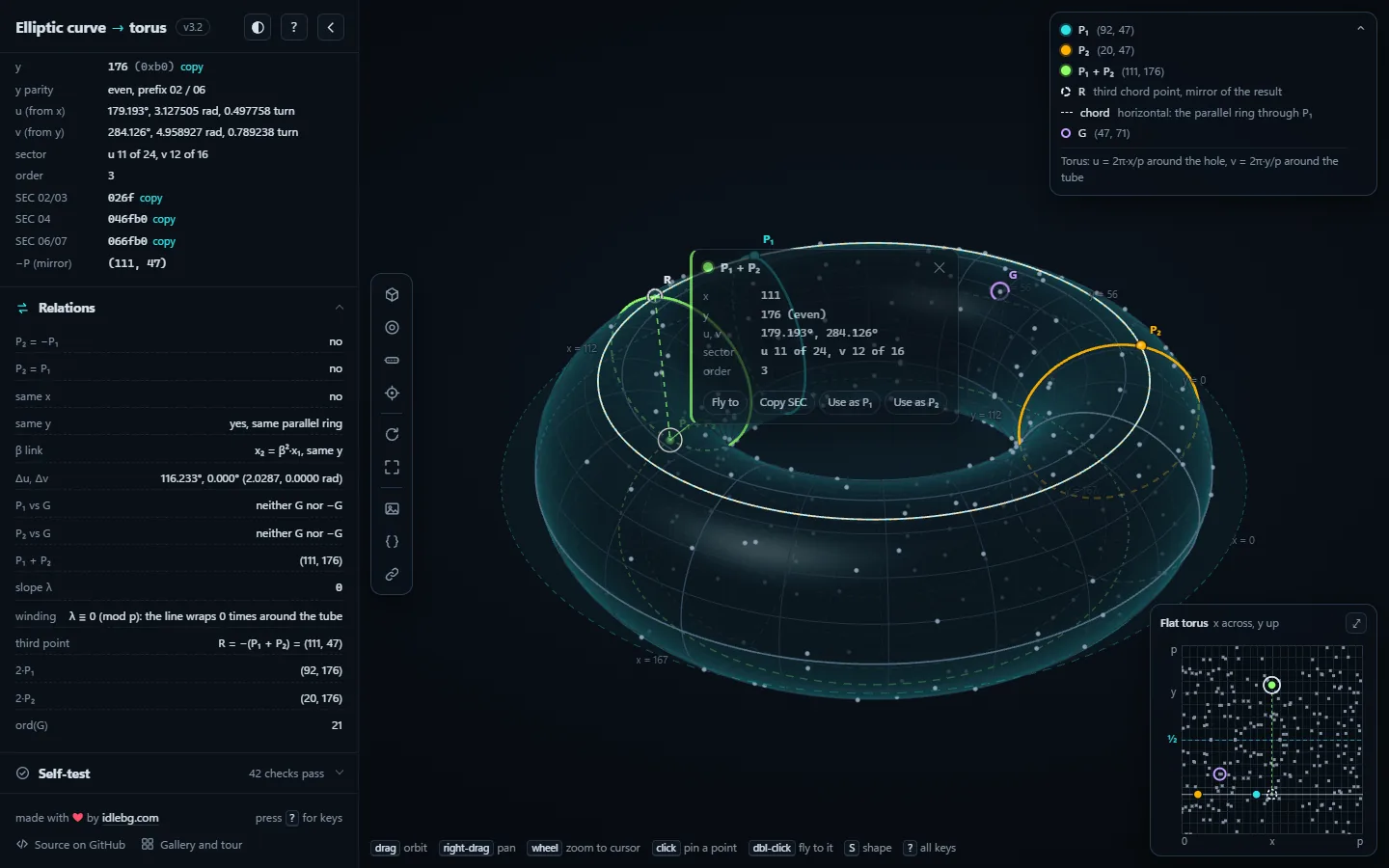
(92, 47) and (20, 47) have the same y.
Open this view: (92, 47) + (20, 47)
Do it yourself
- In Curve, pick the preset y² = x³ + 7 over F₂₂₃, Programming Bitcoin.
- Type
(92, 47)in P₁ and(20, 47)in P₂. - In the 3D view, click the result to pin its card.
- Read the Relations section in the panel.
Look at: the chord is the ring around the hole at y = 47 (the legend: “horizontal: the parallel ring through P₁”), and Relations says “λ ≡ 0 (mod p): the line wraps 0 times”. The third point on that ring is R = (111, 47), and the sum is its mirror image, (111, 176).
Why: λ = (47 − 47) / (20 − 92) = 0, so the line is y = 47 and never leaves its ring. Three points of F₂₂₃ have y = 47, and 35 The GLV endomorphism explains why points sharing a y come in threes on this curve.
Example 24.4 · Slope 1: once around each way
Open this view: (167, 28) + (188, 49)
Do it yourself
- In Curve, pick the preset y² = x³ + 7 over F₂₂₃, Programming Bitcoin.
- Type
(167, 28)in P₁ and(188, 49)in P₂. - In the 3D view, click the result to pin its card.
- Read the Relations section in the panel.
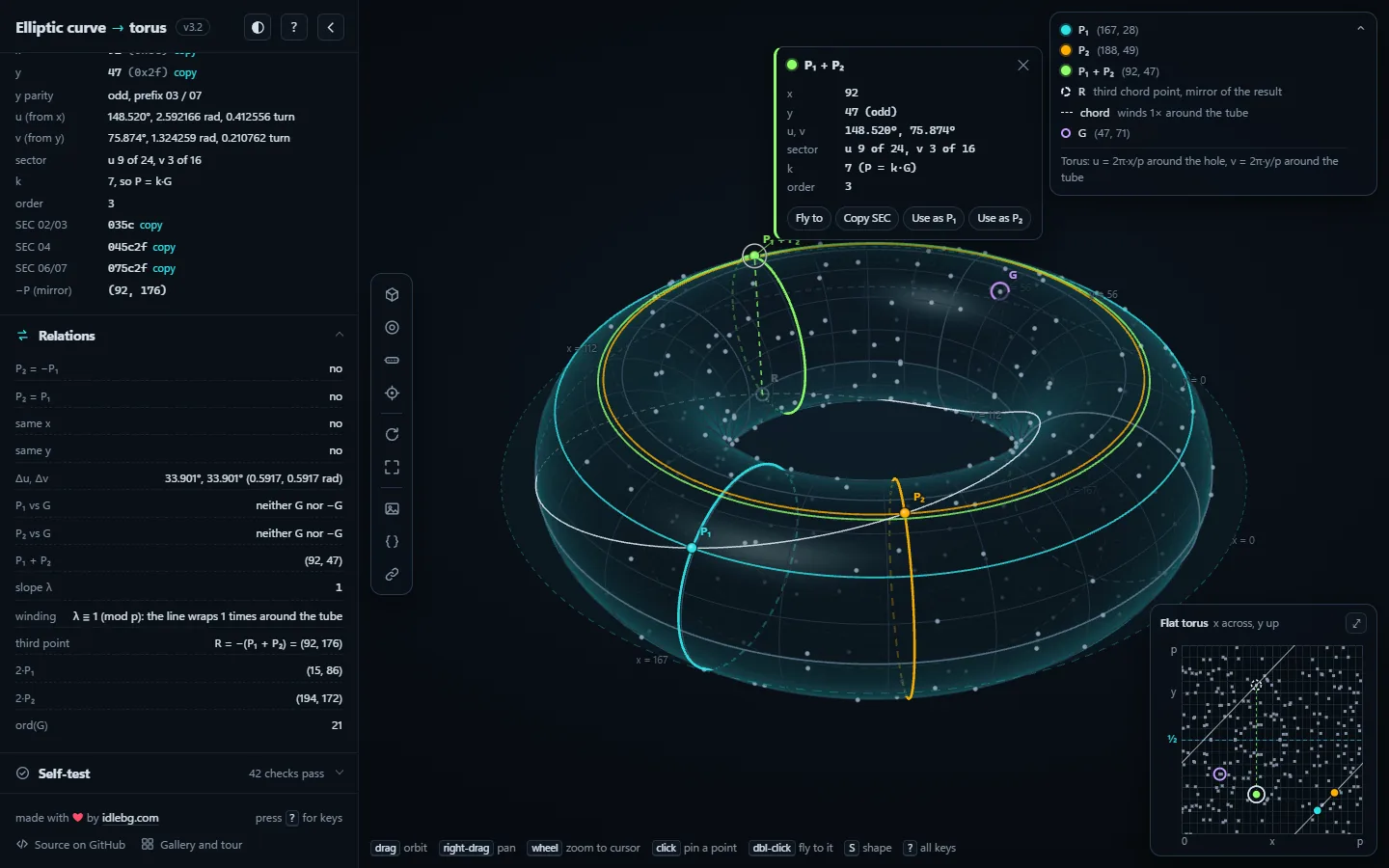
Look at: a line that goes once around the hole and once around the tube, like a stripe on a candy cane. The sum is (92, 47).
Example 24.5 · Slope −1: the other diagonal
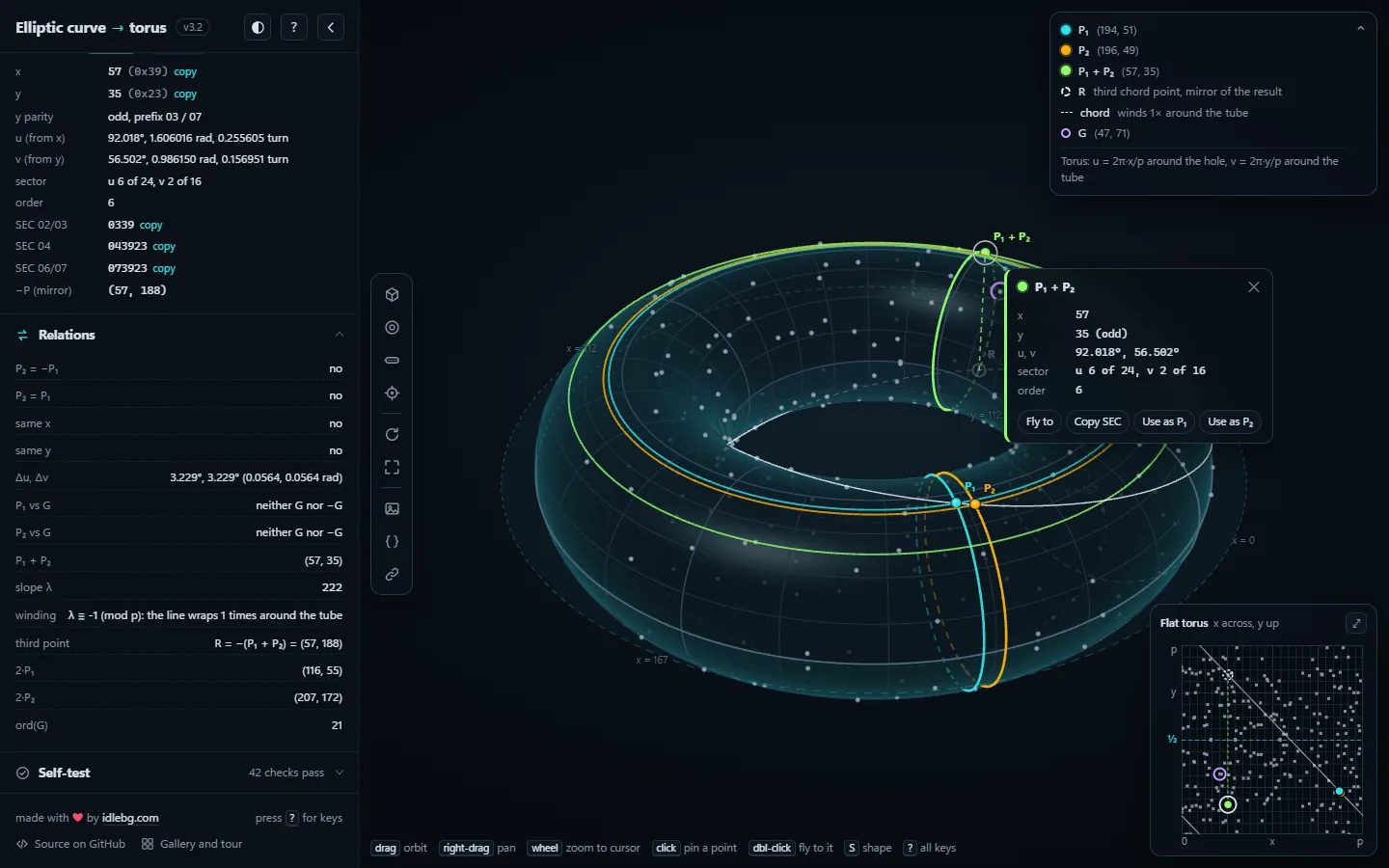
Open this view: (194, 51) + (196, 49)
Do it yourself
- In Curve, pick the preset y² = x³ + 7 over F₂₂₃, Programming Bitcoin.
- Type
(194, 51)in P₁ and(196, 49)in P₂. - In the 3D view, click the result to pin its card.
- Read the Relations section in the panel.
Look at: the slope is 222, which is −1 on the clock: Relations writes the winding as “λ ≡ -1 (mod p)”, and the line winds once around the tube the other way. The sum is (57, 35).
When the line is too steep
Most chords on most curves are steep: λ is a random number on the clock, so its centred value is often in the hundreds. The visualizer draws the continuous line only while it winds at most 24 times; beyond that the flat map shows the line’s p separate points instead (for p up to 4000), and on Bitcoin’s 256-bit curve only R and the mirror step are drawn. 26 Subtraction shows a steep example, and 41 The mapping the details.
Try it yourself
- Add G and 2G on F₂₂₃ (type
Gand2G). What slope does Relations report, and is the line drawn? - Swap P₁ and P₂ with Swap: the sum stays the same, but which point is R?
- Compute 8G + 9G by hand with the formula and check it in the visualizer.
Recap
- P₁ + P₂ = −R, where R is the third point of the curve on the line through P₁ and P₂.
- λ = (y₂ − y₁)/(x₂ − x₁) mod p, x₃ = λ² − x₁ − x₂; the line is y ≡ λx + c.
- On the torus the line winds |λ| times around the tube (λ taken closest to 0); Relations and the legend report it.
Next: 25 Doubling: the tangent.